Kigali Genocide Memorial, Rwanda - Field Notes +
I don’t believe in “trigger warnings,” but I’m gonna give it.
Trigger fucking warning.
This is a post about a genocide memorial, people.
And I’m going to make this one public against my better judgment.
I went to the Kigali Genocide Memorial today. I was hoping it would help me answer questions for my research—questions about grand strategy, reconciliation, post-conflict rebuilding. But what I found was not clarity. I found a form of humiliation. Humiliation at thinking I could learn something here that would help others. Humiliation at being from a country that absolutely could have, and should have done something, but did worse than nothing.
I’m supposed to be making sense of how nations recover after civil war. But today reminded me that not everything can be made sense of.
I felt suffocated in there. I don’t do well in enclosed spaces with a lot of people. The hostess kept walking through and spraying some kind of air freshener or disinfectant—to mask the body odor from the visitors, I assume—but it was so bad… so stifling. It made it all worse. And with so many people at certain bottlenecks, I wasn’t sure I wasn’t going to need to find the nearest exit ASAFP. I am now glad that I brought the albuterol that the doctor gave me. It is hard to breathe here in Kigali with the pollution and charcoal. If I close my windows, the heat is stifling. If I keep them open at certain times of the day when there’s no breeze, I’m coughing up stuff.
After the museum, I stopped by the Nyamirambo Women’s Center, which is an organization for women—to sustain self-reliance. They train and employ women from the community to improve their livelihoods. They do this thing—community-based tourism where they offer a local walking tour, a hike to the mountain top, a cooking class, basket weaving, and a sewing class. I’ll be taking the last three.
I spent a lot of money on gifts today, but thanks to the generosity of some of you, I had to. I wanted to send the promised postcards for whatever tier that was. And for my biggest contributor, a small gift of appreciation from the Nyamirambo Women’t Center. Spending money here feels like the absolute least I can do. As much as I can, I’m trying to find tours and network with locals rather than go through large touring outfits—even though I know those employ a lot of people too.
Tomorrow, I’m going on a city tour with a guide who is highly rated. She even offers a “Kigali nightlife“ tour. That would have been tempting 20 years ago maybe. I’m not gonna lie—I’m worried about the form of transportation she uses: the motos. I’ve yet to try one of those. Today was terrifying at a couple of intersections. When I say they drive crazy here, I don’t mean aggressive or fast. I mean we almost hit head-on with another vehicle—and several motos—many times. Lanes are a suggestion around curves, up and down hills, and at very strange and confusing intersections. There is organization, and the roads are beautiful in Kigali, just that no one cares about safety in many places.
But, back to the Kigali Genocide Memorial. When you go to the reception, you pay $30 for an audio tour. That’s actually quite expensive for Kigali prices, but the tour takes you through the museum. Mostly, it’s panels on walls with photos and info translated into three languages. There’s a room with beautiful Rwandan sculptures that represent the phases of the genocide in Rwanda. Then there’s a room filled with skulls and bones of the victims. There’s a room with photos, hung by remaining family members. Some of them are the only photos ever taken of these individuals.
And then, the worst one—the room with the children.
Life-size, backlit photos of literal babies, little ones, with bright eyes and all innocence. They list some info about them—their favorite foods, best friends, and how they were slaughtered. I hate that word, but there’s no word that does it justice. It wasn’t just murder. It wasn’t just killing. It was brutal slaughter. I’m not even sure the perpetrators would have killed an animal the way they killed their neighbors.
So many stories of neighbors turning on neighbors. So many. All the same. Neighbors who ate together, played together, babysat each other’s kids, were godparents to each other’s children. Some turned their Tutsi neighbors over to what I can only describe as possessed demons, to save their own families. Any Hutu that was caught protecting a Tutsi was also murdered.
I have to also mention the women. Rape was used as a weapon of war. The Hutus were TOLD to rape Tutsi women. Repeatedly. Sometimes hundreds of times, by as many men. At a time when AIDS was a very real threat, known HIV-positive men would be called to where there were Tutsi women to rape. They didn’t just rape the women and children. They mutilated them.
They called the Tutsi “cockroaches,” but a cockroach we kill with a swat or a step. Even cockroaches have a more dignified death.
In a few cases, the perpetrators threw people into latrine pits. So many people in those tiny pits that they trampled each other to try and get out. In one instance, the bodies were ten deep.
What else?
How could there be anything else?
There is.
The fucking priests.
Rwanda was largely Catholic. Many, many people fled to churches to seek refuge. And the priests? Several of them were working with the militia. There are so many churches where people were slaughtered. In some villages, their remains are still there. Their bloodied clothes are strewn about the way their bodies were—discarded. Disregarded.
I cannot, I cannot, I cannot justify or understand or be brought to any modicum of compassion for these priests. I cannot. And some of them are free, still. The Catholic Church—Rome—oh yes, arranged for them to be released from prison.
You may wonder: Why didn’t the Tutsis resist? Why didn’t the Tutsis fight back?
I wondered this, too. In one village, they tried. I’m hoping I can go there, but it’s a drive and rugged terrain to the top of a mountain. There’s nothing there, really, but a memorial. But I want to see the terrain. I want to see the forest that hid these brave resisters, who fought with stones and arrows against an overwhelming number of enemies with guns and machetes. Their story and their end is as tragic as everything else, but I’ll save that for the blog after I go there.
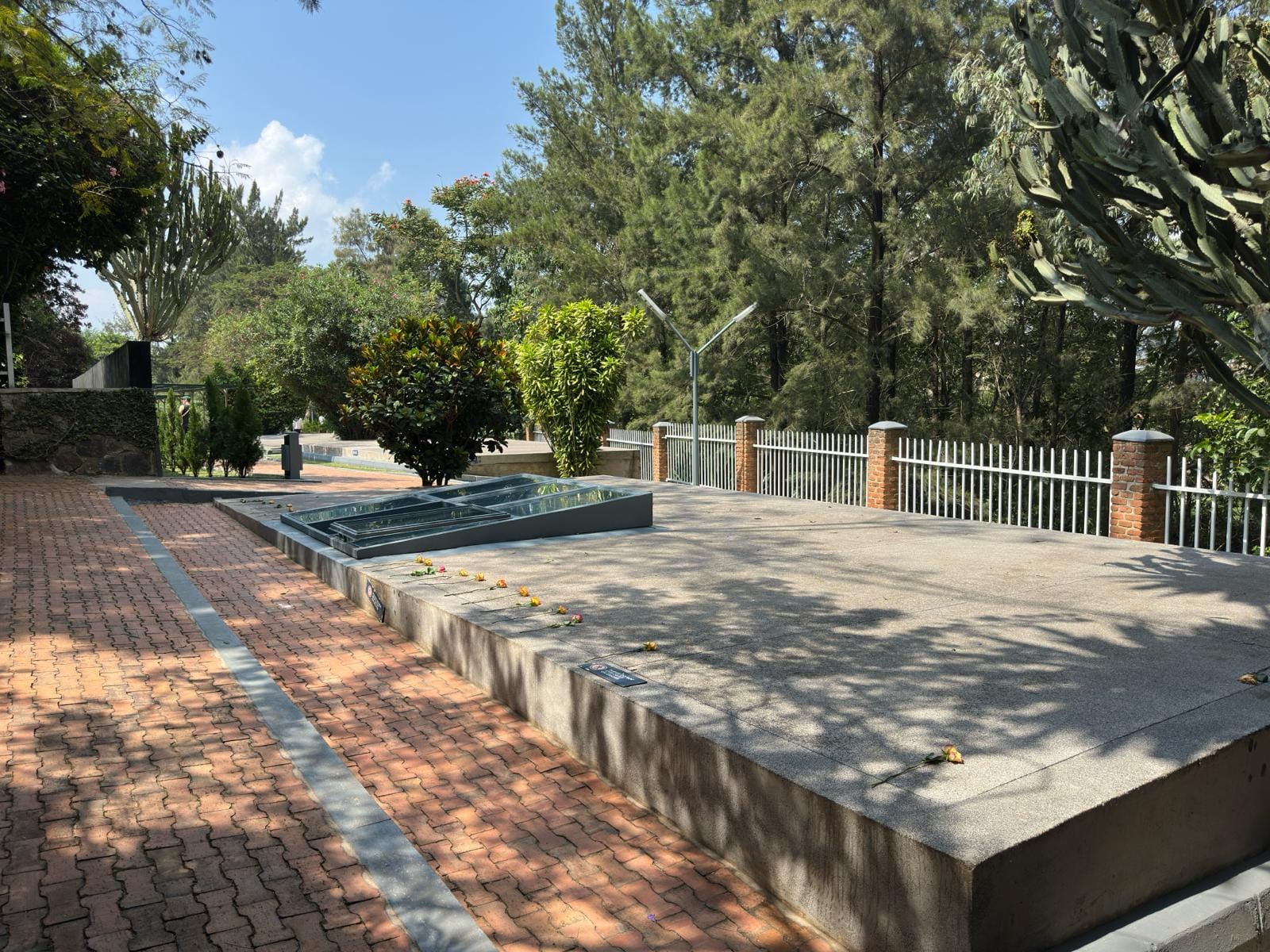
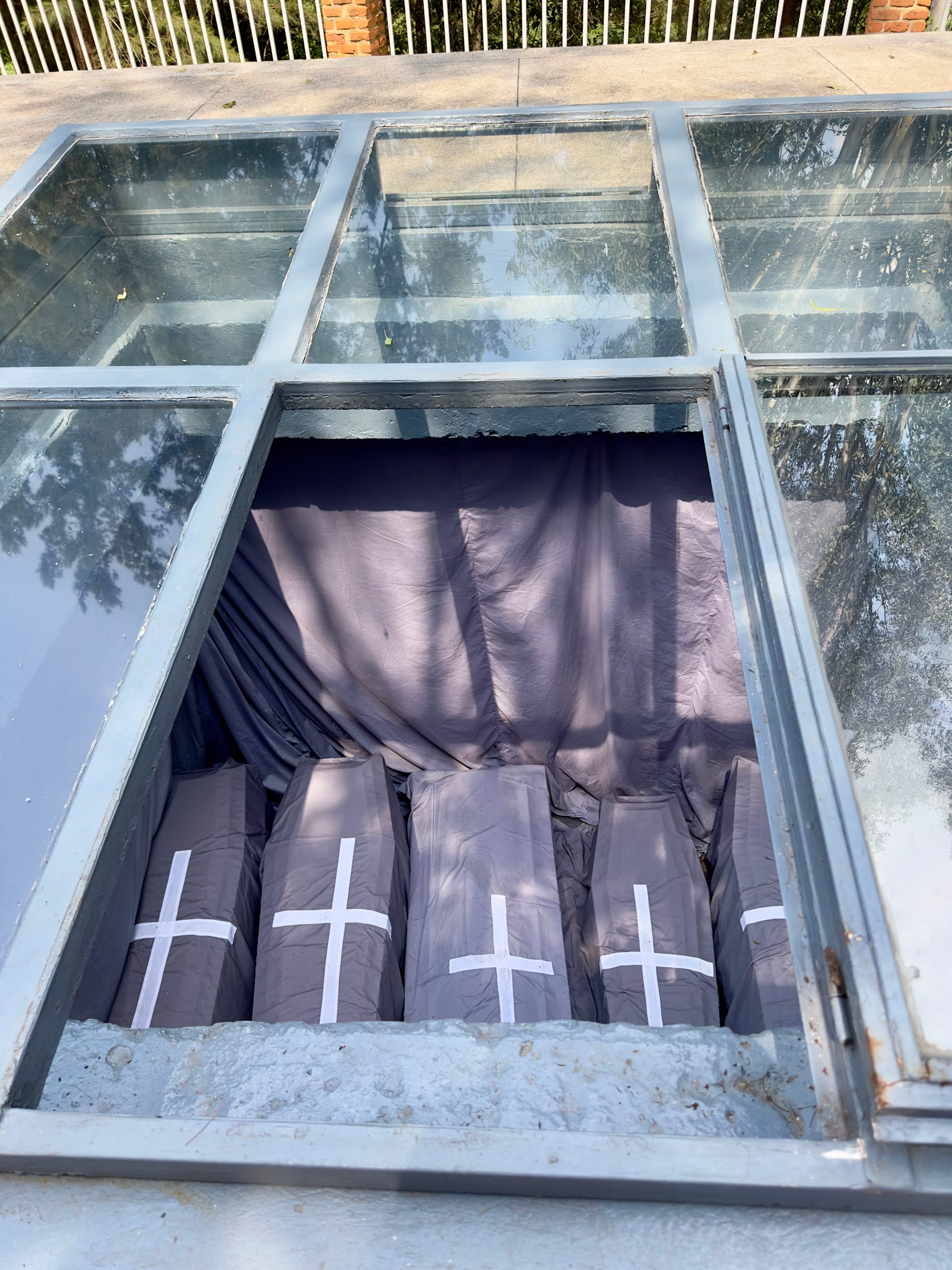
After the indoor tour, you walk outside to the mass grave area. There is a dozen or so of these huge blocks of cement. I’ll attach one of the photos I took. It’s said that there are approximately 250,000 people in these graves. My mind cannot even comprehend that number of people. They are still uncovering bodies and mass graves in much of Rwanda.
When I got to the open mass grave, I got dizzy and nauseous. I almost fell to the ground and completely lost it.
But I pushed on to the gardens. There are three smaller gardens with fountains that each represent a stage of the genocide including symbolism of the international community turning their backs on Rwanda. They’re under construction, but the audio explained what they’ll look like and why they’re laid out the way they are.
Beyond this was the café. I wasn’t hungry anymore, but I needed to sit. I needed a moment. I wanted to spend some money there. Thankfully, it was quiet, with the lunchtime rush long gone. I ordered some traditional Rwandan food and just sat there, numb, as I waited.
When the food came, I ate as much as I could. They give big portions here, and I’m always mindful that the food I am able to waste is a privilege. I didn’t know what to do, so I just ate.
Finally, I went to the gift shop where I got a few cards for subscribers and a book by Flaurette Annely Akariza titled Rebounce: Transgenerational Resilience in Rwanda. It had a phoenix on the cover, so of course it caught my eye. Among insights and tips on how to overcome horrible experiences, the book includes “30 messages the world can learn from Rwanda…”
This is it. Maybe.
A small voice that grew louder with every step at the memorial today has been chastising me for this entire trip and idea.
Who the fuck am I?
How can I—or anyone for that matter—come to this country and truly understand what happened here?
I’m basically a fucking tourist. And I am ashamed of that.
This isn’t my specialty or my major. When I schemed up this project, I couldn’t even tell you which side committed the genocide. I only knew it involved Hutus and Tutsis. I knew more than most people I’d mentioned the trip to—but still, embarrassingly little. The two places that exposed me to the horror that mankind is capable of was Burma and Rwanda. I can’t go to Burma.
And now I realize: no matter how long I’m here this summer, I will never understand even a fraction of what I would need to, to truly grasp how reconciliation works. Or what it can teach us.
I thought I’d come and learn how to prevent division and bring people and communities together, but I see the similarities in what’s happening in our country and the history of this place—and I just feel afraid.
I also wonder what the point is.
Many say the Rwandan Genocide could’ve been stopped, but I’m not so sure. Maybe it could’ve been stopped that day, but it would have happened eventually. A majority of Rwandans didn’t just wake up one morning and decide to butcher their neighbors and hack up babies. It’s easy to look at them as unintelligent, uneducated, evil. But that’s not Rwandans at all.
It started the way it’s starting in the U.S.
With a natural division of ideologies.
Fueled by deliberate division—
in media, in news, on the radio.
The Hutu government and extremists pushed the narrative that the Tutsis needed to be exterminated like cockroaches. There were so many lies. But psychology and history both show: when you hear something enough, you start to believe it.
We see this in our country now.
Foreign interference.
Malign influence campaigns.
Extremists in our own government.
When random incidents of violence against Tutsis happened, people didn’t stop it. It was far from their lives, or so they thought. And that’s how it really started. It festered, until it seethed. It was strategic. They had a plan.
In our own country, we see resistance. We see peaceful protest. We see neighbors standing up when masked men in unmarked vehicles grab people off the streets.
Please think about this for a moment.
If masked men in unmarked vehicles tried to take me, I would fight. Oh, I would so fucking fight. And if I happened to be carrying that day, I would defend myself.
But this has become normal. And a lot of people on the far right are fueling it.
If you’d asked me years ago whether I thought enough agents would actually go along with this, I’d have told you hell no. But now we have an ever-growing number of agents who have no issue doing this. When people, just in the last few months, asked me if Soldiers would do this, I said fuck no. I am not so confident anymore.
How did those men get to that point where this is an acceptable way to make a living?
In a free country where they can easily leave their jobs without the threat of being killed? Some people join the military to protect, to serve, to defend. Some join because they want an excuse to exert power. To beat or kill—legally.
These so-called agents of the law aren’t killing people. Yet.
But I still can’t reconcile how they got to this point so I cannot assume they won’t get to that point.
I don’t know. I just know we have to keep making our voices heard that this is not okay.
That we are not going to stand for it.
We have to keep demanding that the media tell the truth and holds government officials accountable.
We have to keep stepping up to serve in public roles, even when it’s dangerous.
We have to vote.
We have to stop scrolling and start calling, emailing, showing up.
And right now? We need true Republicans to step the fuck up.
Come get your MTGs and your LBs, y’all.
Where is your line? Because when the Hutus came for the Tutsis, they didn’t just kill Tutsis. They killed moderate Hutus too.
You are not as safe as you think you are. The only group of people who can most quickly and efficiently stop what is happening on the extreme right, are the moderate to right people.
I fucking beg you to listen to your conscience and do something so that when we are reading this a couple of years from now, it will seem like nothing but alarmist paranoia.
(Also, some local Rwandans are doing karaoke somewhere close. They’re singing La Bamba. I can’t make this shit up.)
Member discussion